- English
- Español
- Português
- русский
- Français
- 日本語
- Deutsch
- tiếng Việt
- Italiano
- Nederlands
- ภาษาไทย
- Polski
- 한국어
- Svenska
- magyar
- Malay
- বাংলা ভাষার
- Dansk
- Suomi
- हिन्दी
- Pilipino
- Türkçe
- Gaeilge
- العربية
- Indonesia
- Norsk
- تمل
- český
- ελληνικά
- український
- Javanese
- فارسی
- தமிழ்
- తెలుగు
- नेपाली
- Burmese
- български
- ລາວ
- Latine
- Қазақша
- Euskal
- Azərbaycan
- Slovenský jazyk
- Македонски
- Lietuvos
- Eesti Keel
- Română
- Slovenski
- मराठी
- Srpski језик

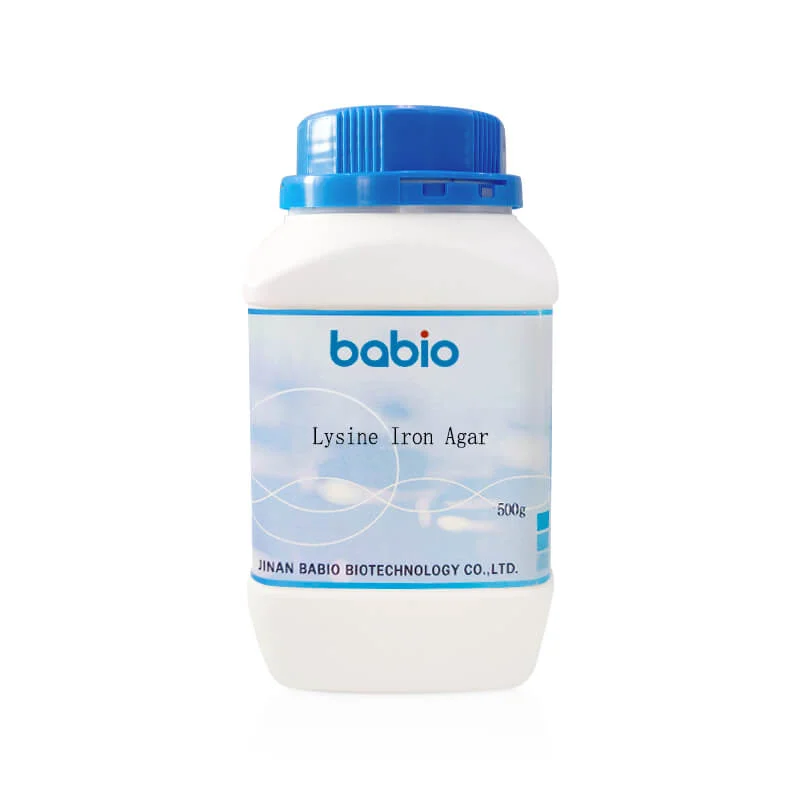
Lysine Iron Agar (LIA)
BABIO’s Lysine Iron Agar helps differentiate enteric bacteria by detecting lysine decarboxylation and hydrogen sulfide production. Essential for microbiological testing.
Send Inquiry
Product Description
Lysine Iron Agar (LIA), manufactured by BABIO, is a specialized microbiological medium designed for the differentiation of enteric bacteria. It allows for the identification of microorganisms based on their ability to decarboxylate or deaminate lysine and produce hydrogen sulfide. This versatile medium is ideal for distinguishing between various enteric bacilli in clinical and research settings, particularly for studies on lysine decarboxylase activity and hydrogen sulfide detection.
The formula includes peptic digest of animal tissue (5.0 g/L), dextrose (1.0 g/L), L-lysine hydrochloride (10.0 g/L), and sodium thiosulfate (0.04 g/L), with a final pH of 6.7 ± 0.2 at 25°C. Ferric ammonium citrate and bromocresol purple enable visual differentiation, as the medium changes color during microbial activity, and the presence of hydrogen sulfide leads to a blackening of the medium.
Lysine Iron Agar is critical in microbiological testing for its ability to differentiate enteric organisms based on their enzymatic activities, making it an essential tool in both food hygiene detection and clinical microbiology. It supports robust growth and facilitates precise microbial identification by monitoring bacterial reactions with lysine and sulfur compounds.
Specifications:
- Packing: 250g / 500g
- Formula: Peptic Digest of Animal Tissue (5.0g/L), Dextrose (1.0g/L), L-lysine Hydrochloride (10.0g/L), Sodium Thiosulfate (0.04g/L), Ferric Ammonium Citrate (0.5g/L)
- Storage: Store tightly sealed at 5-30°C
- Shelf Life: 3 years from manufacturing date
For accurate identification of enteric bacteria and hydrogen sulfide detection, trust BABIO’s Lysine Iron Agar. Learn more about our microbiological media on BABIO’s official website.
Hot Tags: Lysine Iron Agar, enteric bacteria, hydrogen sulfide detection, lysine decarboxylase test, microbiology medium, peptic digest, bacterial differentiation, BABIO
Related Category
Pharmacopeia Medium Series
Cosmetic Detection Series
Food Hygiene Detection Series
Plant Tissue Medium Series
Biochemical Identification Culture Medium Series
Characteristic Product Series
Send Inquiry
Please feel free to give your inquiry in the form below. We will reply you in 24 hours.